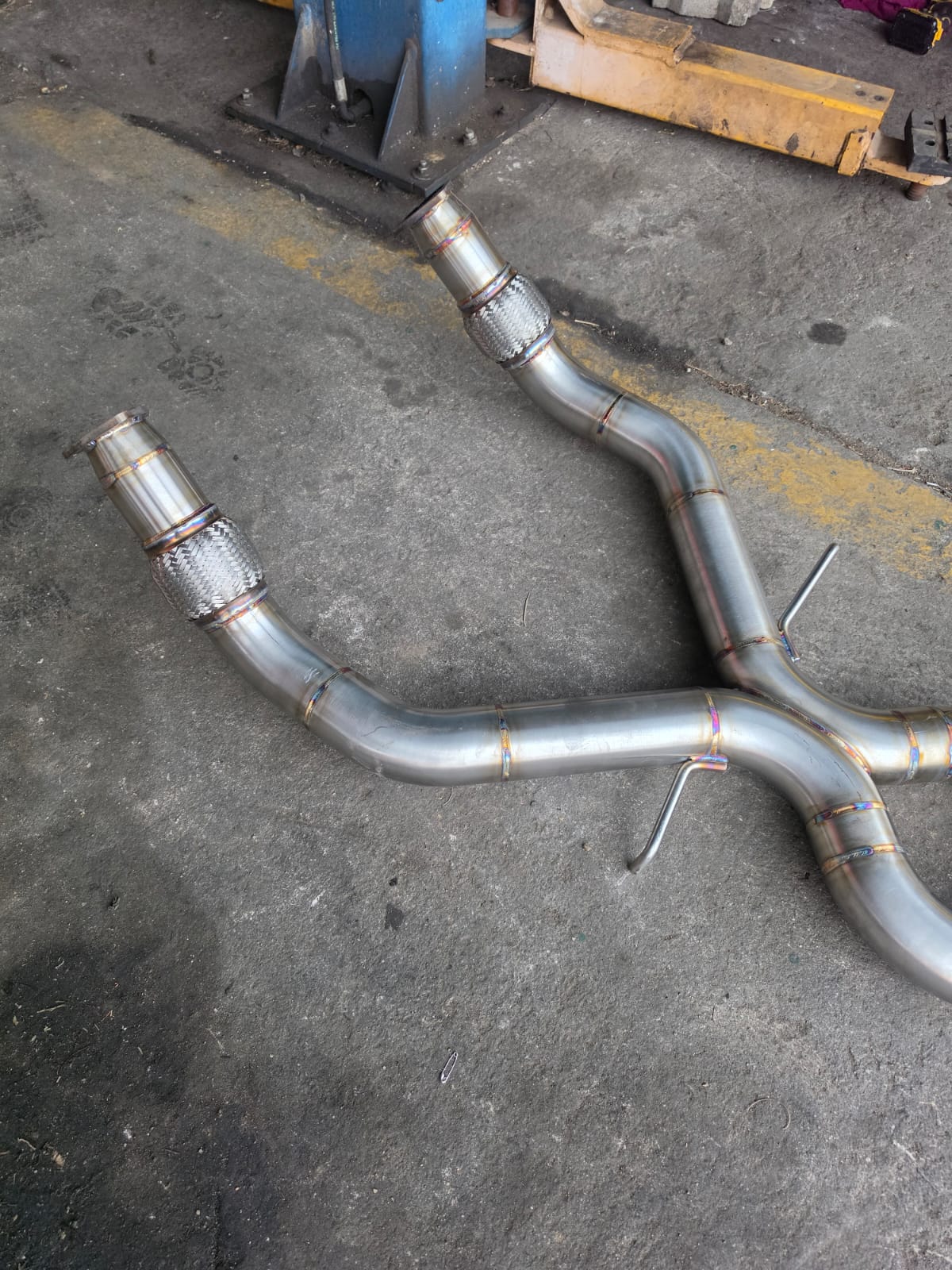
Parts made and fitted at 123 Marina Road. Stainless pipework, TIG-welded in the workshop and measured on the car it's going onto. If you only want the part, say so. If you want the part and the map, the file is written for the part that was fitted.
A Stage 1 map doesn't need any of them. Stage 2 starts with a downpipe. Stage 3 is a turbo plus the fuel and the cooling that have to match the air that turbo moves.
That's why a fabricated part takes a few days, not an afternoon. Each step is checked on the car before the next one.
Measure on the car
Flange to flange, around the subframe, the steering and the heat shields.
Cut and shape
Mandrel bends where they fit, pie-cuts where the space is tight.
Tack and test-fit
Tacked together and offered up to the car. Adjusted until it fits without stress.
TIG weld out
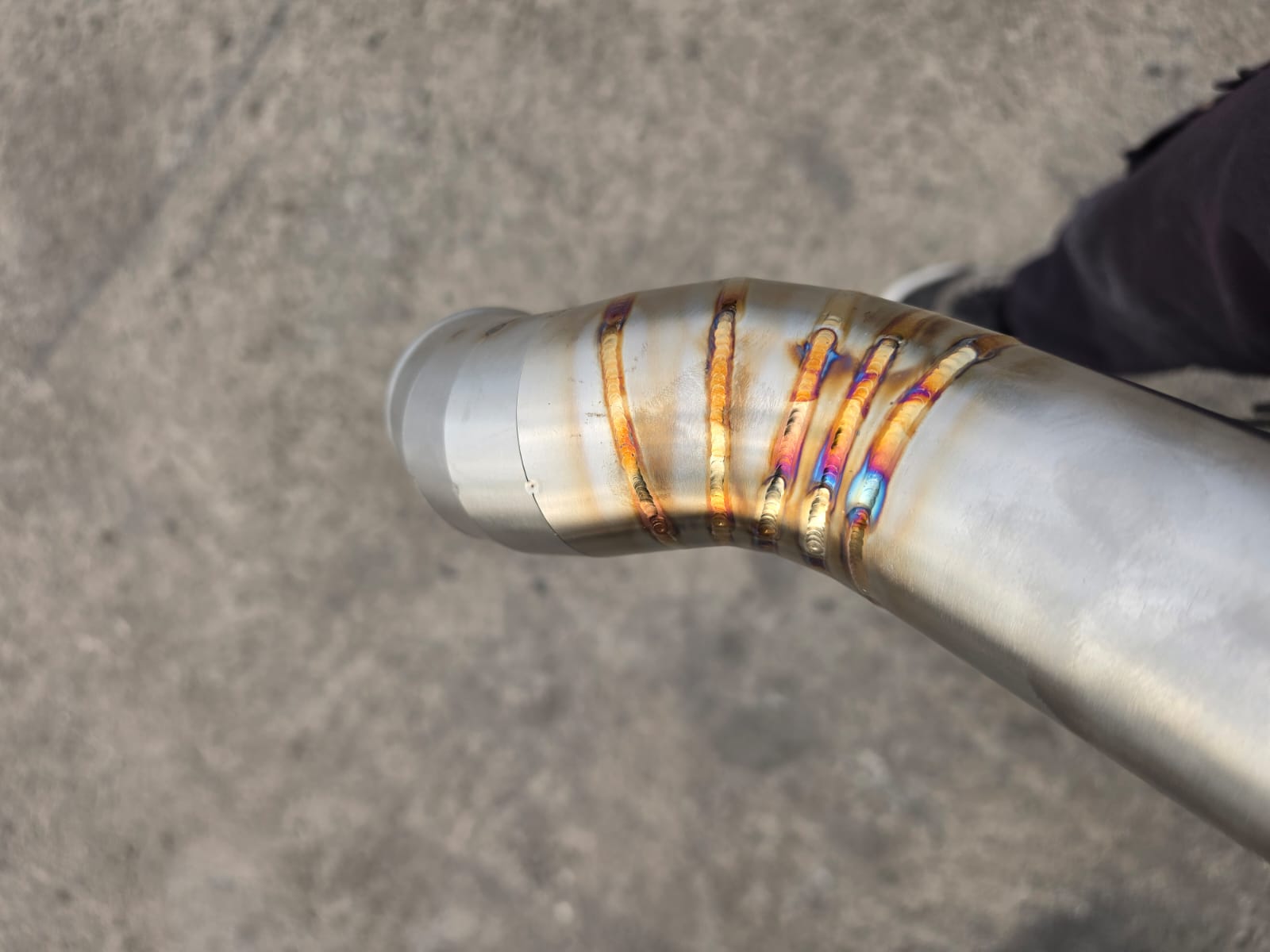
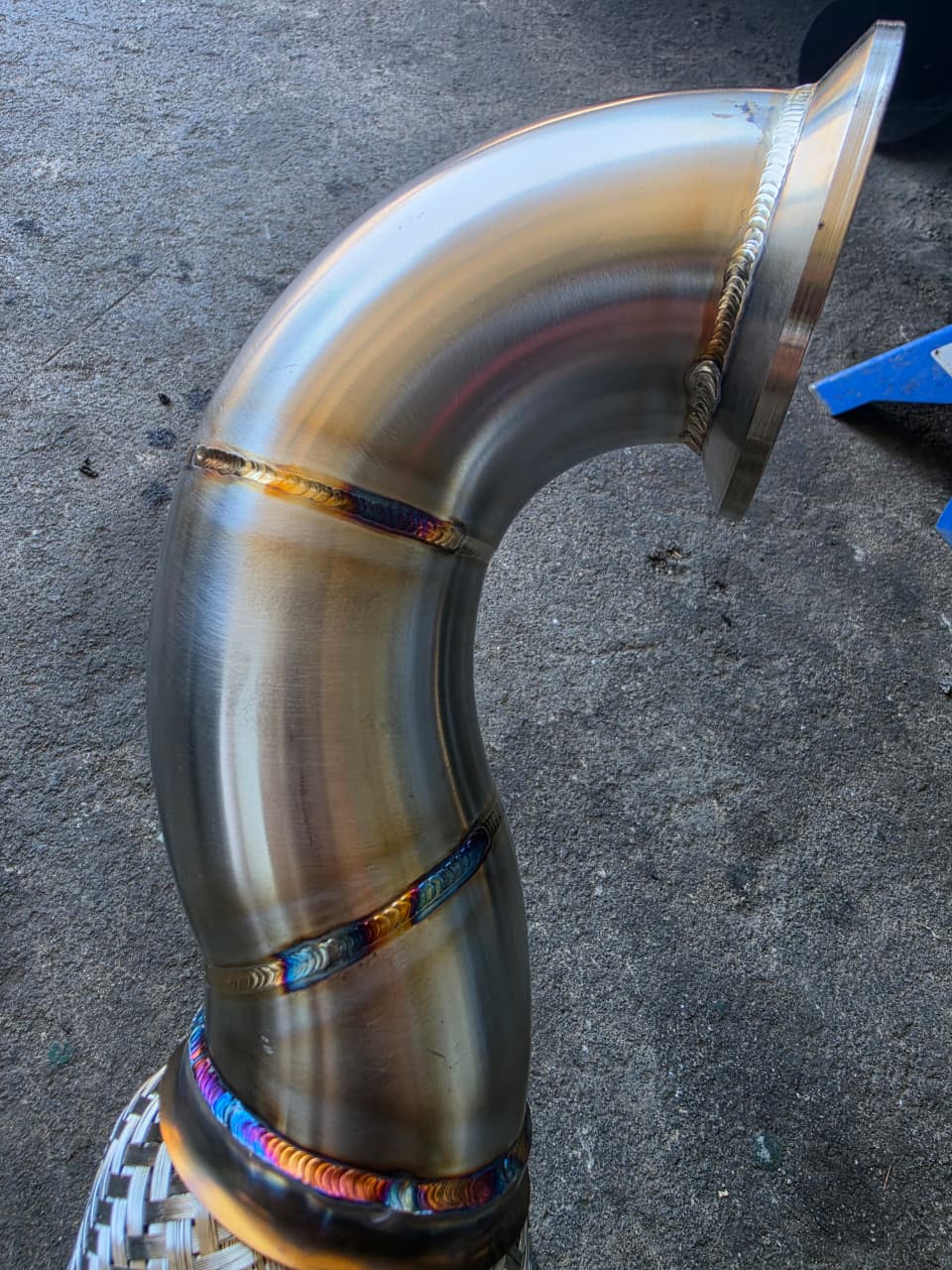
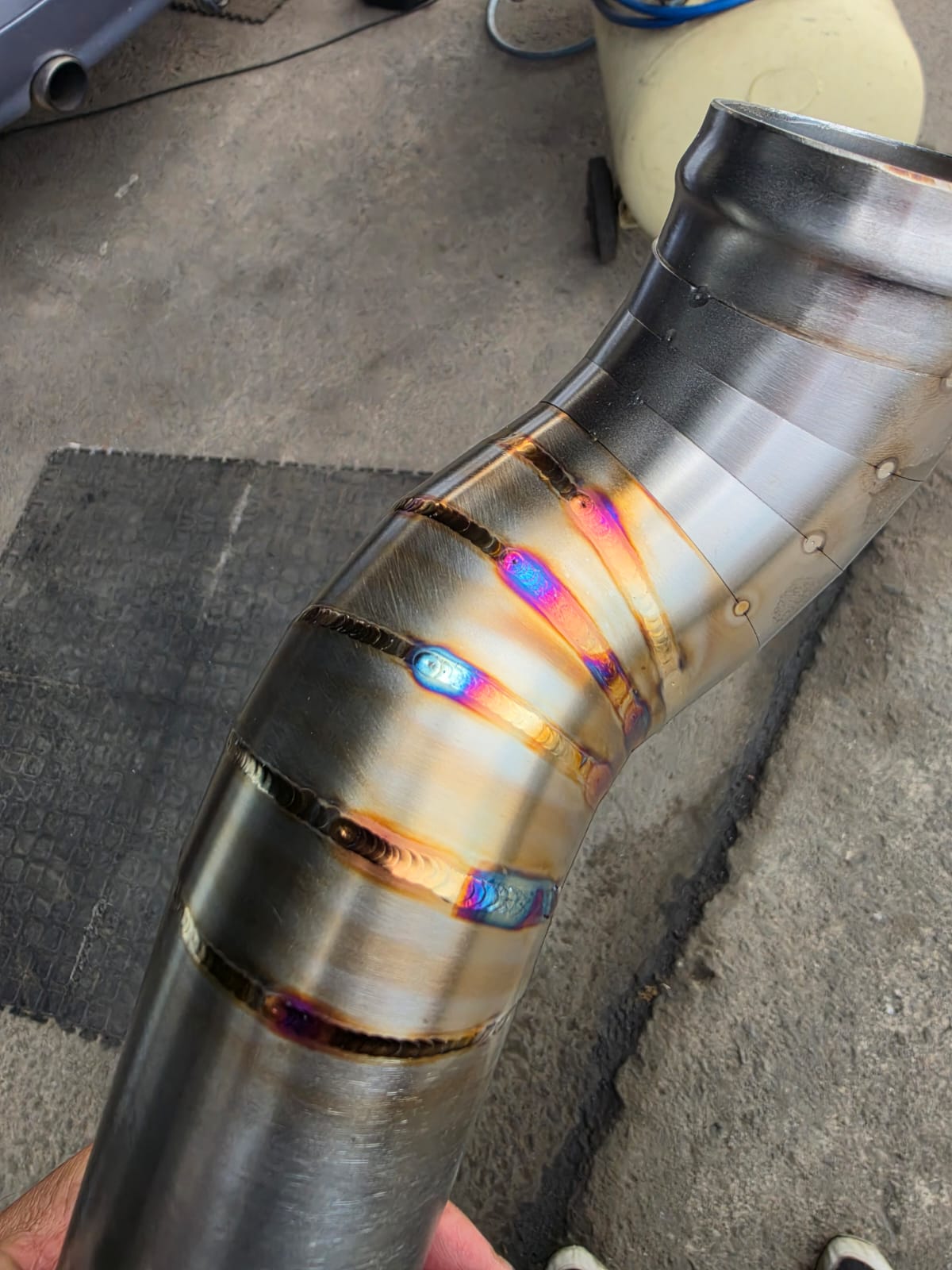
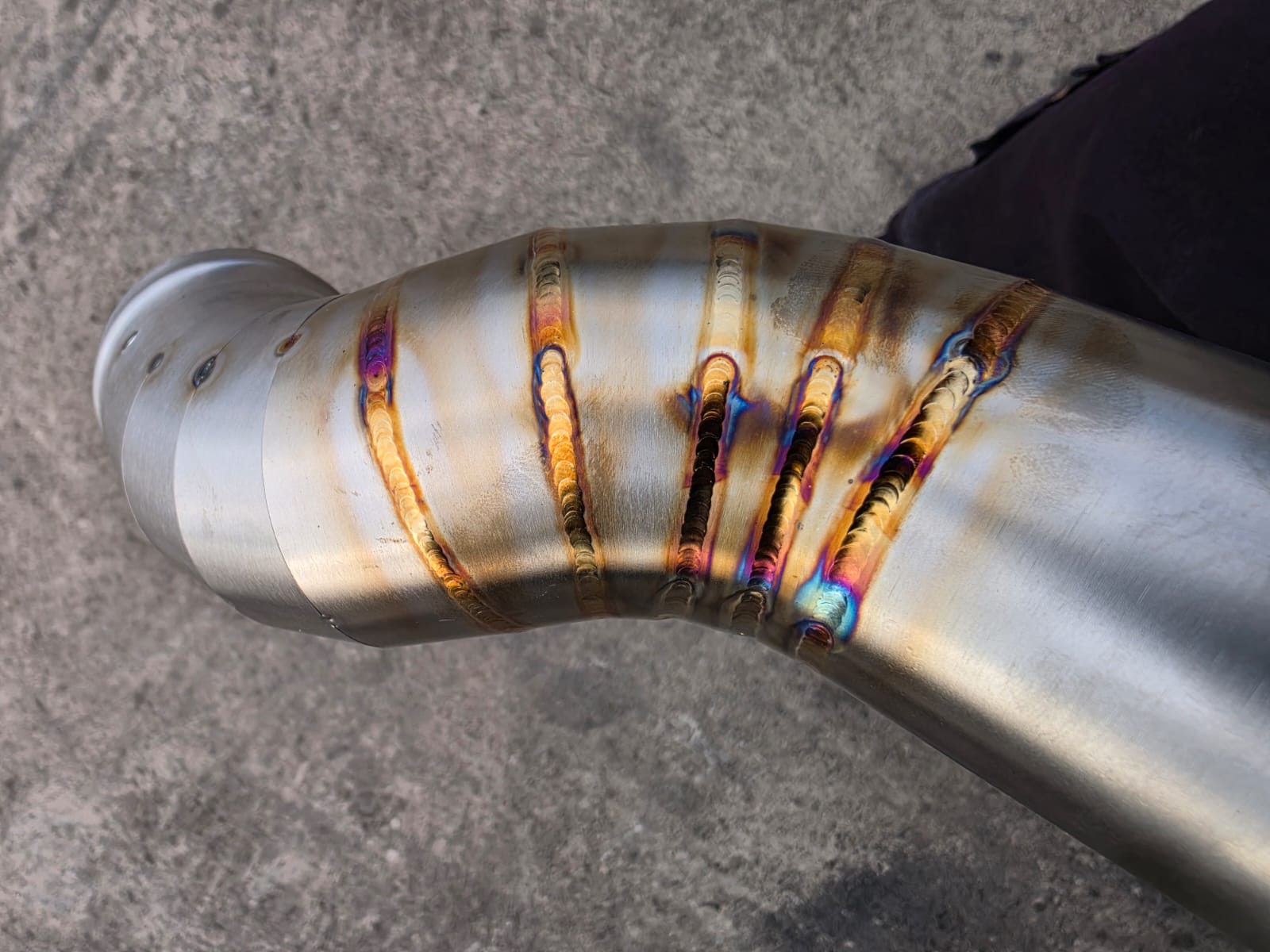
Fully welded off the car. The colour in the welds is the heat tint of TIG on stainless.
Fit and check
Fitted, checked for leaks and clearance, and mapped if the job includes a file.
Bends
Pie-cut vs mandrel
Both keep the full inside diameter through the bend. A press bend doesn't, which is why we don't use one.
Pie-cut
Short wedges of straight pipe, cut at an angle and TIG-welded into a bend. Each joint is a small change in direction, so the radius can be as tight as the space needs.
Best for
Tight spaces around a turbo, a subframe or a steering rack
Radius
Very tight, chosen per bend
Look
A row of coloured weld rings
Mandrel bend
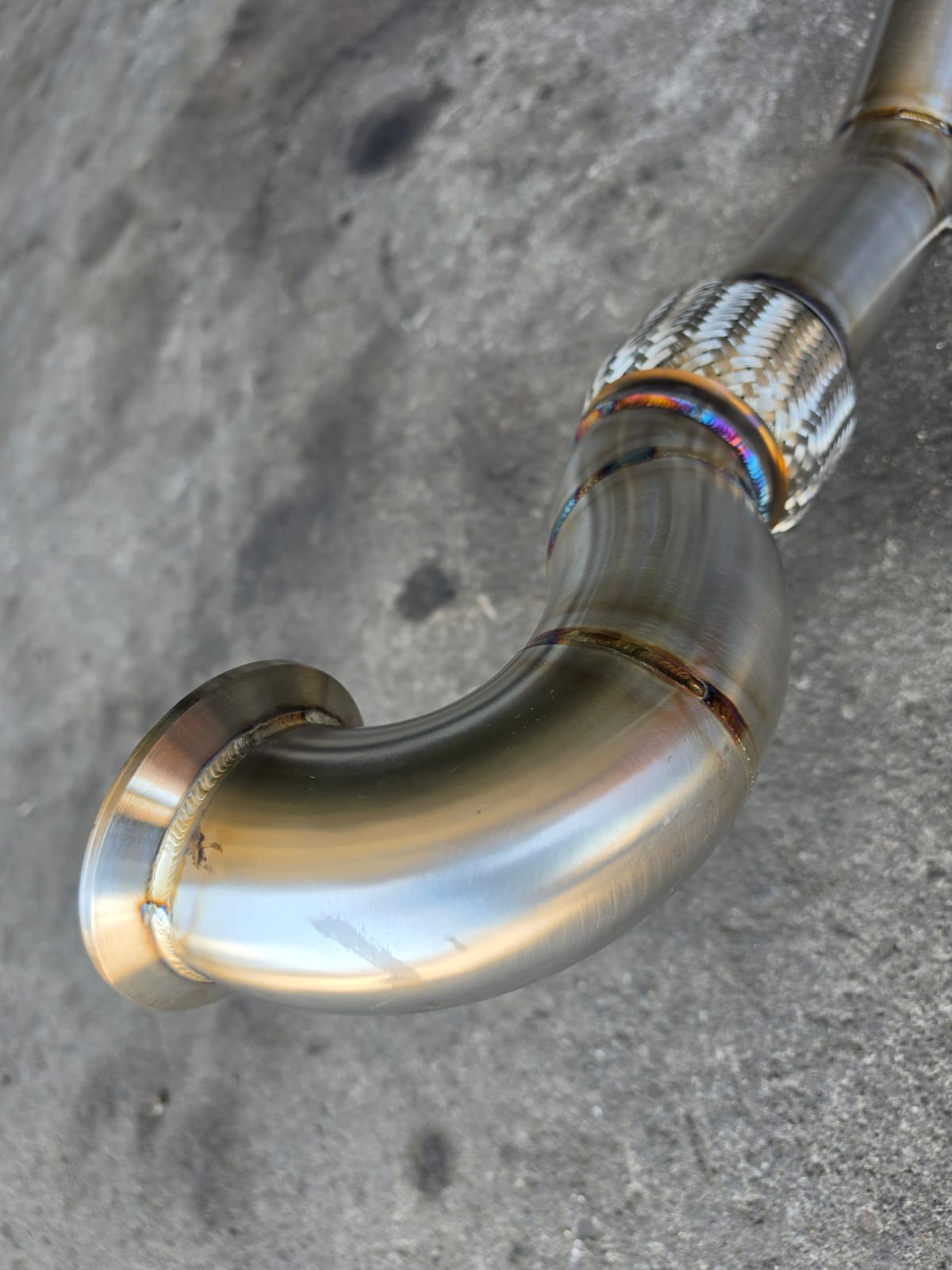
Pipe bent over a mandrel that supports it from the inside, so the bend doesn't crush the internal diameter the way a press bend does. One smooth sweep with no joints in the bend.
Best for
Longer runs and sweeping bends with room to work
Radius
Set by the bend, larger than a pie-cut
Look
Smooth, few welds
Part details
Every part
What each part is for, when it's needed, and how it fits into a tuning stage.
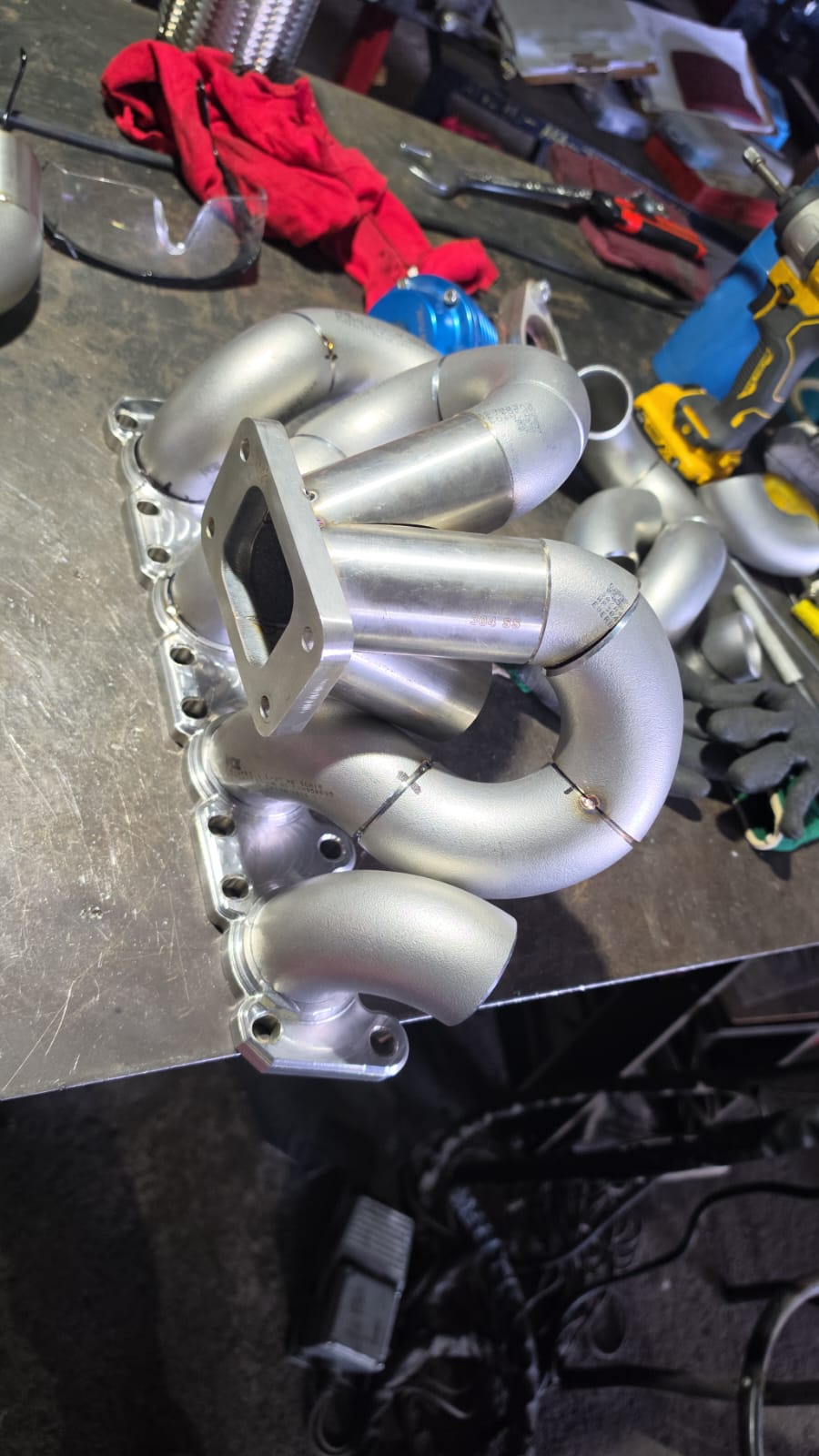
A big-turbo conversion takes the factory turbo off and fits a larger one. A hybrid is the smaller step: the factory unit rebuilt with more airflow, rather than a completely different turbo. Both exist so the engine can move more air. The workshop also makes the manifolds that bolt that turbo to the head.
More air needs more fuel, or the mixture goes lean under boost. That's why a turbo and a Stage 3 map get booked together. We don't quote one horsepower number. It depends on the turbo, the fuel system, and the engine.
We match the turbo and the manifold to the engine so it comes on boost cleanly. The choice depends on the car.
Stage 2 needs a high-flow downpipe. If the car doesn't have one, we'll spec it and make it. The freer the pipe off the turbine, the sooner the turbo spools.
The rest of the exhaust is a separate decision. A cat-back is the system from the catalytic converter back, made when the factory rear section is the remaining restriction or when the owner wants a different tone. Manifolds are made when the factory manifold is the restriction at the head. Pipe is mandrel-bent, or pie-cut where the space is tight, so the bends don't crush the internal diameter the way a press bend does.
The sound follows the pipe diameter, the length, and how much silencing you want. Those choices change the flow as well.
High-flow downpipe, required for a Stage 2 map.
Cat-back, when the rest of the system is part of the job.
Manifolds, usually with a turbo conversion.
Mandrel-bent or pie-cut pipe on the sections made in the workshop.
A custom intake replaces the airbox when the box is the restriction under boost. More air reaches the turbo, or the throttle, with less pressure drop. Throttle response is what drivers usually notice, and it is easier to feel once a map or another part is already asking for that air. On its own, an intake is a Stage 2 recommendation, not a requirement.
An intercooler upgrade is for heat. A small cooler heat-soaks, the intake temperature climbs, and the map has to pull timing. You feel that as the car going flat on a long pull, or in traffic. A larger cooler lets the file stay where it was written.
Boost pipes are the hoses and hard pipes between the turbo, the intercooler, and the throttle. A larger throttle body is the last restriction in that path. They get replaced when the factory pieces collapse under boost, or when their diameter is smaller than the turbo and the cooler they connect.
These are the parts fitted around a tune, not stages of their own.
Water-methanol injection. Optional. Useful on a hard Stage 2 car and in hot weather. It won't stand in for an intercooler that's already heat-soaked.
Boost gauge. Fitted where you can see it, so you know what the turbo is doing.
Blow-off valve or diverter valve. When the throttle shuts, the boost that was in the pipe has to go somewhere. A blow-off valve vents it. A diverter valve sends it back to the intake. The workshop fits the one that matches the car.
Fuel system. Injectors and a pump sized for the air a bigger turbo moves. This is part of Stage 3, not an accessory for a stock turbo.
Cooling. The intercooler, and the related hardware, when heat is what is limiting the map.
05Just the part, or the part and the map
Both are fine. If you only want the part, say so and we'll make and fit it. If you want the part and the map, say that too. The file is written for the part that was fitted, not for a generic stage, so the two are best done in the same visit.
Need a part made?
Send the car, what's on it now, and what you want made. Photos of the space it has to fit help.